


After the attack on the wedding procession in Udaipur, a Dalit bride proudly took out a Bindooli procession, with the Bhim Army acting as a protective shield.
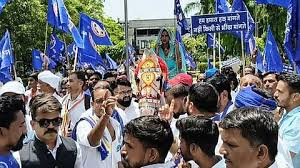
After being forced off the horse, the Dalit bride gave a befitting reply, taking out a historic Bindooli with the Bhim Army on the streets of Udaipur.
Rajasthan: A Dalit bride in Udaipur has strongly challenged the casteist mindset prevalent in society. Just eight days after the attack on her wedding Bindooli (wedding procession), Pooja Meghwal proudly took out a symbolic procession. Dressed in a turquoise blue dress and riding a white horse under a red-gold umbrella, Pooja held pictures of Mahatma Jyotirao Phule and Savitribai Phule in her hands.
The entire incident began on April 29, when Pooja’s Bindooli procession was being held in the Dhira Talai area of Hariav, which falls under the Dabok police station area of Udaipur. It is alleged that some women and men strongly objected to her riding a horse and leading the procession outside their house, despite being Dalit. The protest escalated to the point where the bride was pulled off the horse.
According to the FIR filed by the bride’s father, Bhairulal Meghwal, the attackers used casteist slurs and threatened bloodshed if the procession was not stopped. The DJ was shut down, guests were pelted with stones, and attacked with sticks, rods, and swords. Several people were injured in the stampede, and women’s mangalsutras and other valuable jewelry and watches were looted.
Following the incident, the police registered a case under several sections of the Indian Penal Code (IPC) and the SC/ST Act. The FIR was filed against Laxman Singh, Madhu Singh, Kishan Singh, Uday Singh, Arjun Singh, Takhat Singh, Fateh Singh, Vikram Singh, and Manju Kanwar.
Instead of being deterred by the attack, Pooja and her supporters organized a massive and peaceful march from Udaipur’s Town Hall to the Collectorate on May 7th. This symbolic Bindoli was led by the Bhim Army and other caste organizations. Most of the participants wore white clothes and blue scarves. They carried the statue of Dr. B.R. There were blue flags bearing Ambedkar’s image, posters chanting “Jai Bhim” and demanding the rights of marginalized communities.
Pooja’s father, Bhairulal, expressed his pain, saying that he simply wanted to show that he, too, is human and a resident of this country. He lamented that even after nearly 80 years of independence, the mentality of untouchability persists in society. He stated that such incidents are constantly occurring against Dalits in the Mewar region, and he has submitted a memorandum to the administration against this.
Roshan Meghwal, Senior Vice President of the Udaipur Bhim Army, also strongly questioned this evil practice. He said that it is because of the struggles of great figures like Savitribai Phule that women have gained equal rights in every field today, so why are they being prevented from riding horses? He said that while the country is celebrating “Amrit Kaal,” Dalits are being dismounted from horses, which violates everyone’s right to live equally in this democratic country.
The memorandum also highlighted that such incidents are common in the region. A similar incident occurred in Chittorgarh a few days ago, while last year, three Bindoli processions had to be carried out under police protection in Tadavara, Rajsamand. Activists appealed to the administration to root out this casteist mentality.
In the memorandum submitted to the administration, the Bhim Army stated that only four people have been arrested so far in this case. They demanded that the Arms Act be added to the FIR, as Takhat Singh is alleged to have attacked with a sword. They also demanded that several other individuals involved in the attack be named.
The march, which concludes with a memorandum, demanded an immediate end to the daily discrimination against the Dalit community in all districts of Rajasthan. This included preventing them from drawing drinking water, barbers refusing to cut their hair, barbers barring them from entering temples and public places, and even discrimination at crematoriums after death. The administration was urged to ensure strict enforcement of the law.
Rajan Chaudhary
Courtesy: Hindi News