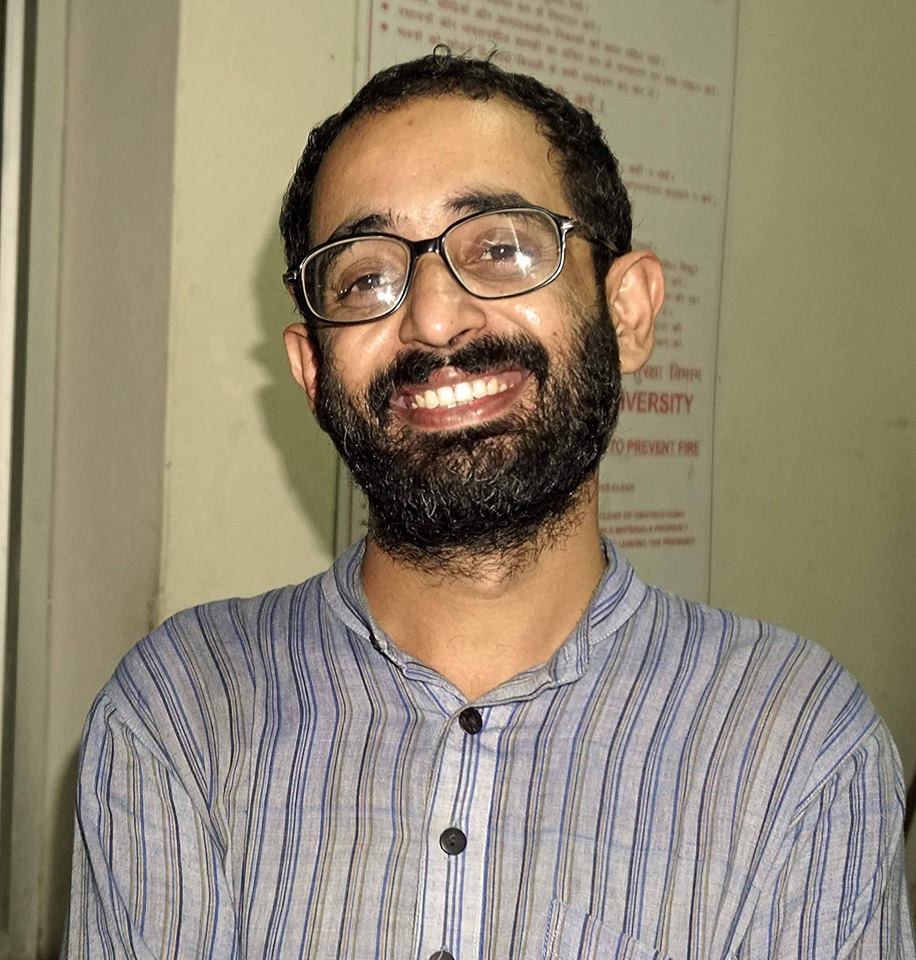
We are pleased to share that the latest book by our esteemed contributor, Dr. Lenin Raghuvanshi, Kashi, is now available on Amazon at a reduced price. Kashi is far more than a book about a sacred city. It presents Kashi as a living civilizational space shaped by centuries of interaction among Hindu, Buddhist, Jain, Sikh, and Islamic traditions. Through a thoughtful and critical lens, Dr. Raghuvanshi highlights the contributions of marginalized communities—including Dalits, Muslims, widows, sanitation workers, and weavers—whose lives and labor have been integral to the city’s identity. The book also explores the social inequalities that often remain hidden beneath Kashi’s spiritual image and examines how commercialization and commodification are reshaping its heritage, culture, and livelihoods. 📖 Get your copy today: https://amzn.in/d/0hhodwt6 A compelling read for anyone interested in history, social justice, culture, and the diverse voices that make Kashi a unique symbol of India’s civilizational heritage.
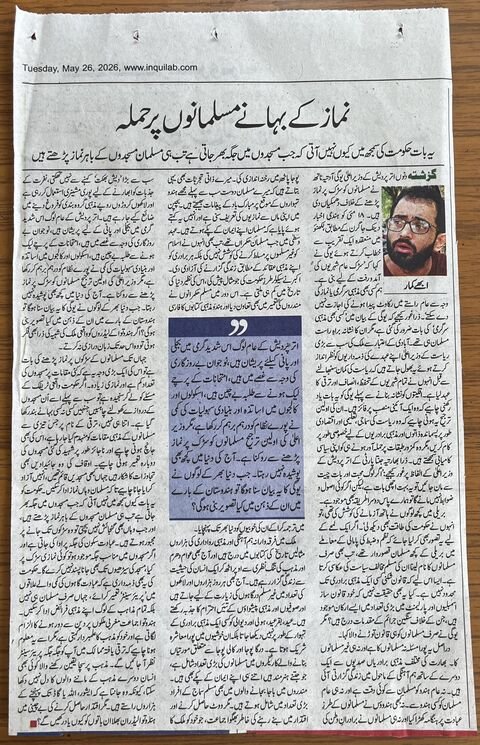
Dr. Abhay Kumar has shared his article highlighting concerns over the targeting of Muslims in Uttar Pradesh on the pretext of offering prayers on roads. He argues that many worshippers are compelled to pray outside mosques—on stairways and, at times, on roads—because existing mosques cannot accommodate the growing number of devotees. In this context, he questions why the UP Chief Minister singles out Muslims when members of other religious communities also conduct religious activities in public spaces. The article further notes that the shortage of mosques is a significant factor behind prayers being offered outside mosque premises. Rather than using threatening rhetoric against the minority community, Dr. Kumar suggests that the government could consider opening the many mosques currently under state control or restrictions. He also points to the broader issue of mosques that have either been encroached upon or demolished in the name of development. Drawing a comparison with Western countries, he observes that many have established multi-faith prayer spaces where people of different religions can worship together, despite often being criticized by Hindutva groups as materialistic societies. Dr. Kumar contends that instead of focusing on divisive rhetoric for electoral gains, political leaders should prioritize public welfare and social harmony. While such narratives may yield short-term political benefits, he warns that they can ultimately undermine national unity and cohesion. These and related concerns are discussed in detail in Dr. Abhay Kumar’s article published in the Urdu daily Inquilab on May 26, 2026.



It is the strategy of elites to pit one group of minority against the other, such as Dalits against Muslims and Muslims against Dalits. This is the divide and rule strategy. The reality is that both groups are marginalized and exploited, but in different areas. It's an agenda of the state to create confusion against the communities. We must try to work to build the ‘unity of oppressed.’
It took centuries of struggle by Dalit-Bahujan leaders – including Jyotirao Phule, Iyothee Thass, BR Ambedkar, Baba Mangu Ram, Periyar, Aiyyankali, Narayana Guru, and others – to unveil casteism and expose the anti-human religious structure. What bothers today is how blatantly the state looks for opportunities to snatch away the constitutional rights and civil liberties of her citizens, particularly those hailing from oppressed sections of society in the creation of Hindu Rashtra.
Iqra University Airport Campus, Main Shahrah e Faisal, Wireless Gate, Karachi
+92 21 34572746
info@sarimwatch.org
We use cookies to improve your experience on our site. By using our site, you consent to cookies.
Manage your cookie preferences below:
Essential cookies enable basic functions and are necessary for the proper function of the website.
Statistics cookies collect information anonymously. This information helps us understand how visitors use our website.
Google Analytics is a powerful tool that tracks and analyzes website traffic for informed marketing decisions.
Service URL: policies.google.com (opens in a new window)
You can find more information in our Cookie Policy and Privacy Policy.