


Now, the issue of caste discrimination in Prayagraj has heated up, with the High Court taking a serious view of the allegations made by a National Law University student.
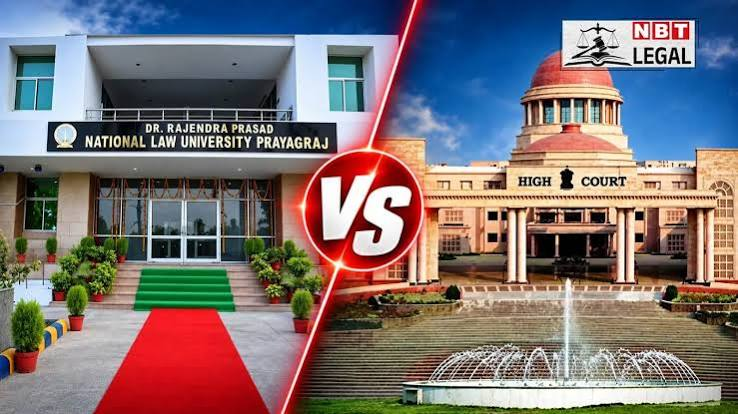
A Dalit student at Rajendra Prasad National Law University in Prayagraj has accused the warden of caste discrimination. The Allahabad High Court, considering it serious, has formed an independent inquiry committee.
Dalit student alleges caste discrimination at Prayagraj NLU; High Court orders investigation
New Delhi: Caste discrimination is a serious issue in universities, where the foundation for students’ futures is laid. Considering the alleged caste discrimination and harassment of Dalit students at Dr. Rajendra Prasad National Law University in Prayagraj as serious, the Allahabad High Court has ordered a judicial inquiry. The case relates to a petition filed by a BA LLB (Hons.) student and a PhD scholar. The students allege that the Head of the Law Department and the Warden of the Boys’ Hostel made comments regarding their caste and reservations and influenced their academic evaluations. The veracity and authenticity of the matter is yet to be established, and therefore, no allegations have been proven at this time. Dalit students allege discrimination; what’s the whole matter?
This case arose following a petition filed by two students at Dr. Rajendra Prasad National Law University in Prayagraj. One petitioner is a PhD scholar at the university, while the other is a fifth-semester LLB (Hons.) student. Both students reside in the university hostel. They allege that the Dean of the Law Department and the hostel warden abused their authority and subjected them to caste-based insults. They also suspect that their answer sheets in their examinations were evaluated more strictly based on caste.
Hearing in the High Court, then an inquiry committee formed
- A single bench of Justice Vinod Diwakar in the Allahabad High Court heard the students’ petition. The petition stated that the students had previously filed a complaint with the Vice Chancellor, but despite repeated reminders, no action was taken against Dr. Sharma.
- The petition alleges that the warden made comments on several occasions about the students’ caste and the reservation benefits they received.
- During the hearing, the Court stated that the allegations are serious and require an impartial investigation, after providing the accused academic, who is also the warden, a full opportunity to present his or her side and be heard.
- The Court appointed Judge Archana Singh of the Small Causes Court in Prayagraj and Chief Judicial Magistrate Arun Kumar Yadav to investigate the allegations. The next hearing in the case is scheduled for September 24.
- The High Court has ordered the person concerned to be relieved of all administrative responsibilities until the investigation is completed. They are also directed not to be involved in the evaluation of the petitioner student’s answer sheets.
The investigation will require the Committee to determine whether Scheduled Caste or Scheduled Tribe students have been subjected to caste-based humiliation or discrimination by Respondent No. 6 or any other person employed or profitably employed by the University, and whether the University has taken action in accordance with applicable regulations to address the complaints.
Focus and Scope of the Inquiry Committee
The Inquiry Committee, appointed by the court, is to investigate whether alleged caste-based humiliation or discrimination occurred against SC/ST students and whether the university responded to complaints in accordance with applicable regulations. The Inquiry Committee will also hear the warden’s side of the case and attempt to gather evidence. The Committee has been directed to take necessary steps to protect the identities of the students testifying. A deadline has been set for the Committee. It has been directed to submit its investigation report to the Court in a sealed envelope before the next hearing on September 24.
What are the legal aspects under the Constitution and the SC/ST Act?
- Article 15 of the Indian Constitution prohibits the State from discriminating on the basis of caste and allows for special provisions for backward classes, including SC/STs.
- Article 14 of the Constitution provides constitutional protections related to the principle of equality, and Article 17 provides constitutional protections related to the abolition of untouchability.
- Depending on the circumstances and specific facts of the allegations in the case, the provisions of the Scheduled Castes and Scheduled Tribes (Prevention of Atrocities) Act, 1989 may also be relevant, but the court order has not definitively confirmed the applicability of any specific criminal section in this case.
The Legal Path Forward
First, a committee constituted by the Allahabad High Court must investigate the allegations and the actions taken by the university and submit its report, after which the High Court’s stance will be decided. The next hearing in the case is scheduled for September 24, 2026. Only then can we hope that the truth will emerge.
Authored by: Manish Raj
About the Author
Manish Raj is currently serving as Consultant Legal Editor at Navbharat Times Online. He began his journalism career 24 years ago with a leading national news broadcast media channel like Rashtriya Sahara.
Courtesy: Hindi News